What you will learn
Structured data is a way to state facts in a machine-readable format. It can help a platform understand a product, event, recipe, article, organization, breadcrumb, or other defined entity. It is most valuable when it agrees with what a customer can see and when the team can keep it accurate.
Why this matters
Markup often fails because it is treated as a shortcut to a visual result. Teams add unsupported reviews, stale prices, invisible FAQ answers, or vague entity data, then struggle to understand why a feature does not appear. Accurate markup starts with the actual page and product data.
A disciplined implementation creates a useful data contract. Writers, product managers, engineers, and legal reviewers agree on which facts are displayed, where they come from, when they change, and what should happen when data is missing.
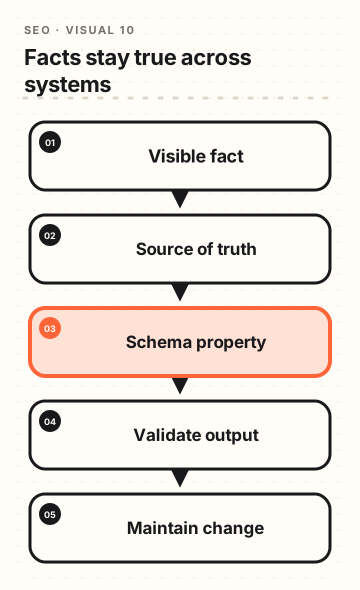
The structured-data contract
Core concepts
Visible content is the anchor
Only mark up information that a user can find on the page and that accurately describes the primary entity. A product page can state real price and availability; an article can identify its author and publication date; a breadcrumb can reflect the trail people see.
Use it when: Can a customer locate and verify every important marked-up fact on the page?
Entity choice comes before properties
Choose the primary thing the page is about, then use the most fitting supported type. A page cannot become five unrelated things because the team wants more features. Keep the entity model simple and truthful.
Use it when: What is the main thing a customer would say this page represents?
Data provenance determines reliability
Prices, stock, reviews, events, author details, and organization information often come from different systems. Document the source, update timing, null handling, approval owner, and behavior when the data is unavailable.
Use it when: What system supplies this fact, and what happens when it is stale or missing?
Validation has several layers
Check syntax, required properties, rendered output, content consistency, platform reports, and production monitoring. Passing one validator does not prove the customer-visible page or feed is correct.
Use it when: Have you checked the live rendered page and the source data, not only a code snippet?
The practical method
- 01
Choose a customer-relevant page type
Start with templates where structured facts help a person decide: products, events, organization details, articles, recipes, videos, or breadcrumbs.
- 02
Read the current platform guidance
Confirm supported types, required and recommended properties, visible-content rules, geographic limitations, and policies before implementation.
- 03
Map visible facts to data sources
Create a table of each property, visible page location, source system, update trigger, owner, and missing-data behavior.
- 04
Generate markup from the same truth
Whenever possible, populate visible content and structured data from the same approved data source. Avoid manually maintained duplicate values.
- 05
Validate representative states
Test normal, discounted, unavailable, missing, localized, long-title, and error states. Inspect both initial HTML and rendered output when JavaScript is involved.
- 06
Monitor changes
Add structured-data checks to template releases, content updates, feed changes, and product launches. Investigate warnings by cohort rather than blindly suppressing them.
Guided workshop
Build a visible-facts markup map before adding structured data
This section turns the lesson into a bounded working session. It is designed to leave you with a source-of-truth map that links every important structured-data property to visible page content, an owner, and a review trigger.
Practice scenario
Practice scenario: A retailer adds product structured data through a plugin. The markup includes old prices from a feed, a rating value that does not match the reviews on the page, and availability that lags behind checkout.
The team sees validation warnings and tries to fix them by adding more markup.
Instead, the team traces each important property to the customer-visible source. It asks who owns the price, inventory, review, and shipping facts; how often they change; and what happens when the source is unavailable. It removes properties that cannot be kept accurate.
The goal is not to qualify for a special display. It is to make the page's factual contract clearer and easier to maintain. The same map also helps product, merchandising, and engineering teams resolve conflicts before they become customer problems.
Build it step by step
Choose a page type and factual purpose
Start with the page's main job: product, article, event, local business, recipe, course, or another appropriate type. List the facts that a visitor can see and reasonably expects to be accurate.
Make it tangible: Save a page-type and facts list. It helps the team decide which properties are relevant to the page's purpose. Check adding every vocabulary property that happens to exist before moving forward.
Map each property to visible content
For every property, point to the exact page element or trusted source that supplies it. Note the text, label, selector, owner, and update path so a reviewer can verify it after a template change.
Make it tangible: Save a property-to-page map. It helps the team decide whether a value is supported and maintainable. Check marking up a fact a visitor cannot see before moving forward.
Identify fast-changing facts
Price, availability, shipping, reviews, hours, and event dates can change quickly. Decide which system is authoritative and how the page, feed, checkout, and markup will remain aligned.
Make it tangible: Save a changing-facts register. It helps the team decide which facts need monitoring or should be omitted. Check publishing a value that only one system updates before moving forward.
Validate meaning and placement
Use appropriate validation tools and manual review. Check that the item described is actually the main item on the page, that repeated components do not create confusion, and that nested entities match the visible experience.
Make it tangible: Save a validation note with page screenshots. It helps the team decide whether the markup describes the page honestly. Check treating a pass in a validator as proof of eligibility before moving forward.
Add release and content triggers
Name the changes that require a markup review: template edits, feed changes, price logic, new markets, review provider changes, or an authoring workflow update.
Make it tangible: Save a structured-data review trigger list. It helps the team decide when the map must be checked again. Check assuming markup is finished once it ships before moving forward.
Keep a removal path
If a property becomes hidden, stale, incomplete, or unsupported, remove or correct it quickly. Preserve the reason in the change log so the team does not add the same unsafe signal later.
Make it tangible: Save a correction and removal log. It helps the team decide how to respond when facts drift. Check leaving inaccurate data because it once passed validation before moving forward.
Working template
Use these fields in a document, task, or spreadsheet. Keep the evidence close to the decision.
- Page purpose: State the page's primary subject and the customer task it supports. A content owner should confirm the page is not trying to describe several unrelated things.
- Visible property: List the exact visible text or component that supports the structured value. A reviewer should be able to locate it without inspecting code.
- Source of truth: Name the system and owner that controls the value. The owner should know how changes reach the page.
- Update frequency: Record how often the fact can change and the risk if it drifts. An operations owner should know whether monitoring is needed.
- Validation evidence: Save the test result, screenshot, date, and reviewer notes. A technical reviewer should be able to compare future changes.
- Removal trigger: Define when the property must be corrected or removed. The team should be able to protect customers from stale facts.
Quality review before you ship
Use these checks while the evidence, owners, and customer context are still easy to correct.
- Read the visible page and its structured data side by side. Every marked-up statement should be something the reader can see, understand, and verify in the same context without hidden qualifications.
- Choose one real-world change such as a new price, author, event date, or product variant. Trace how it updates the page, data source, markup, feed, and review process before calling the implementation complete.
- Treat warnings as prompts to investigate, not a reason to add more labels. The useful question is whether the data accurately represents the customer-facing object, not whether a validator displays a perfect badge.
Decision rules for the real world
A property is not visible to readers
Do: Leave it out unless there is a clear, policy-compliant reason and a visible equivalent.
Avoid: Do not use markup to hide information from customers.
Page and checkout disagree
Do: Fix the source-of-truth flow before changing presentation or markup alone.
Avoid: Do not choose the more attractive value to display.
A validator accepts the markup but the page is misleading
Do: Treat the visible customer experience as the priority and correct the underlying fact.
Avoid: Do not use a tool pass as a substitute for editorial judgment.
A third-party plugin emits unwanted properties
Do: Configure, replace, or constrain the plugin and document the approved output.
Avoid: Do not accept opaque markup because it is easier to install.
Coach notes
- Structured data is strongest when it reflects a factual page that is already clear to a person.
- A property map turns a one-time implementation into an accountable content system.
- Remove uncertain facts. Accurate, smaller markup is better than a broad but unreliable set.
Worked example: a furniture retailer
The retailer adds Product markup to every product page, but sale prices in the markup update only once nightly while the visible page changes in real time. Items marked out of stock remain available in the markup, and variant URLs all inherit the parent colour and price.
The team creates a contract between the commerce system and product template. The visible price and markup read the same variant data, unavailable items use a defined state, and QA covers sale, pre-order, back-order, no-stock, and multi-currency cases.
Marketing stops manually pasting review values into code.
Make it stronger
Model organizations conservatively
Use consistent legal and public-facing names, official URLs, contact routes, and social profiles only where they are accurate. Do not create elaborate organization claims that the site cannot substantiate.
Test migrations like data migrations
A new CMS or frontend can silently drop, duplicate, or change markup. Compare the old and new rendered data for representative templates before launch.
Keep a rich-result incident playbook
If a feed or markup release produces incorrect customer-visible information, stop the source, correct the data, identify affected templates, and record the cause. Rich-result appearance is secondary to factual accuracy.
Current guidance
Use structured data for facts, not a shortcut
Structured data can help a search engine understand accurate, visible facts. It does not guarantee a rich result, a ranking increase, or an AI citation.
- Mark up only information a visitor can see on the page. Feed the page and the markup from the same approved source whenever possible.
- Test the live rendered page, not only a code snippet. Check normal, missing, unavailable, discounted, localized, and error states.
- Do not add FAQPage markup to chase reach. Google says FAQ rich results are generally limited to well-known government and health sites.
- Do not build a HowTo markup plan for Google rich results. Google has deprecated HowTo rich results. A useful how-to page can still help people without producing that feature.
Use this before you publish
- Every important marked-up fact is visible, accurate, and traceable to an owner.
- The team knows which search feature is currently supported before building for it.
- The customer value of the page remains clear even if no rich result appears.
Current field note
Use structured data to describe visible facts
Structured data helps systems understand a page, but it is not a shortcut to a rich result. Mark up facts that are accurate, current, and clearly visible to readers.
- Map each property to the exact visible page element and name its source of truth.
- Validate the markup after a template or content change.
- Remove facts that are hidden, stale, incomplete, or not relevant to the page's main purpose.
Official reference: Google: General structured data guidelines ↗
Lesson artifact
Visible-facts markup map
Design a structured-data contract for one existing page template.
Entity and purpose: Name the primary entity, the customer decision it supports, and the structured-data type you plan to evaluate.
Fact map: List five properties with their visible page location, source system, owner, and update frequency.
State coverage: Describe how sale, missing, unavailable, localized, or error states should appear to customers and in markup.
Validation plan: Choose syntax, rendered-page, content-consistency, release, and monitoring checks before the next deployment.
Before you move on
- The markup describes a real, visible primary entity.
- Every important property has a trustworthy source of truth.
- Visible content and markup use the same approved facts.
- Representative edge states are validated before release.
- The team knows how to monitor and correct data drift.
Put the lesson into practice.
Create a free Spacebrain account and use the SEO suite with your own data providers.