What you will learn
International ecommerce is an operating decision before it is an SEO task. A country may share a language but differ in currency, taxation, delivery time, sizing, payment methods, returns, regulations, cultural expectations, and competitive alternatives.
A useful international program makes the chosen market feel intentionally served rather than mechanically translated.
Why this matters
A translated page can attract visits yet fail when the shopper discovers an unexpected currency, a non-deliverable address, unfamiliar sizing, or a return policy that does not apply. Those failures damage trust and make search visibility less valuable even if impressions rise.
International targeting signals work best when they reflect a real customer experience. Clear market pages, correct language, valid alternate relationships, local commercial facts, and a reliable selection interface reduce ambiguity for visitors and search systems alike.
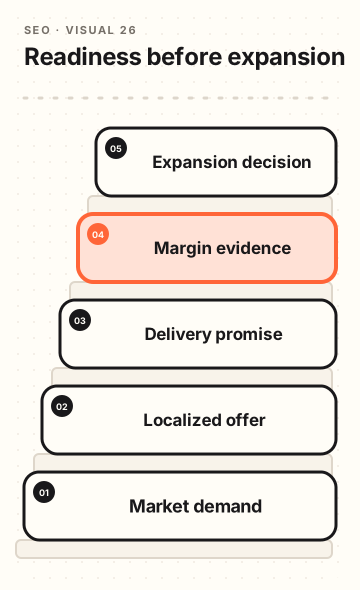
The market-readiness chain
Core concepts
Language and market are different
A French-language experience can serve multiple markets, and a country can require multiple languages. Choose URL and content relationships based on the version of the offer a customer can actually buy, not a simplistic one-language-one-country rule.
Use it when: Does this version reflect a distinct language, market offer, or both?
Alternate relationships
Hreflang helps communicate alternate language or regional versions when each page is a valid counterpart. It needs reciprocal, complete, canonicalized URLs and must match the visible experience. It is not a substitute for translation or market fit.
Use it when: Can every declared alternate be reached, indexed, and understood as the corresponding version?
Localized commercial truth
Price, currency, tax treatment, availability, shipping time, payment options, returns, warranty, legal content, and support contact should match what a customer in the market can receive. These facts are often more important than keyword variation.
Use it when: Could a shopper complete checkout without discovering an unmentioned market restriction?
Contribution margin
International revenue can look attractive while shipping, customs, returns, payment fees, local service costs, and discounting erase profit. Measure qualified demand and contribution, not just sessions or gross sales.
Use it when: Does the reporting include the costs created by serving this market?
The practical method
- 01
Choose a narrow launch hypothesis
Name one market, customer group, product set, price position, and fulfillment promise. State why the business believes it can serve this demand better than it can today.
- 02
Run a market-readiness audit
Verify local regulations, claims, taxes, duties, payment methods, delivery partners, returns, support language, inventory, sizing, accessibility, and customer-service coverage. Record blockers before translation begins.
- 03
Design the version architecture
Choose a stable URL pattern and map language, country, default, canonical, and alternate relationships. Make the selector discoverable, preserve user choice, and avoid forcing visitors to a market based only on IP guesses.
- 04
Localize the offer and content
Use qualified translators and market reviewers. Adapt examples, units, sizing, terminology, delivery and return facts, product availability, and legally required information. Do not simply replace phrases in an English page.
- 05
Validate checkout and feeds
Test the complete buyer path from a market-relevant landing page through taxes, payment, shipping, returns, emails, and support. Verify product feeds, structured data, currency, and availability for the same market.
- 06
Measure profitable learning
Track demand, conversion, cancellations, return reasons, support load, contribution margin, and customer feedback by market and product. Compare with a pre-defined baseline and decide whether to expand or repair.
Guided workshop
Prove international ecommerce readiness before expanding a catalog
This section turns the lesson into a bounded working session. It is designed to leave you with an international commerce readiness matrix covering demand, product eligibility, language, currency, tax, shipping, returns, support, legal content, and measurement.
Practice scenario
Practice scenario: A skincare retailer wants to launch in three countries after seeing international visits to its English site. The product team has not confirmed ingredient rules, returns logistics, currency display, duty treatment, local payment methods, or customer support capacity.
Marketing proposes translating category pages immediately.
The team turns the launch into a readiness decision. For each market and product group, it verifies whether the customer can understand the offer, buy it, receive it, return it, and get support. It also identifies which facts need local legal or operational review.
The result may be a phased launch. One market may be ready for a full catalog, another for informational pages only, and another may need to wait. That is a stronger outcome than publishing pages that promise a commerce experience the business cannot yet deliver.
Build it step by step
Choose a market and product scope
Define the country or region, language, product set, customer segment, and launch purpose. Avoid calling a market ready because it has demand if the underlying offer cannot be fulfilled.
Make it tangible: Save a market-and-product scope. It helps the team decide which launch is actually being evaluated. Check mixing several countries and product lines into one assumption before moving forward.
Validate commercial eligibility
Check product restrictions, certifications, ingredients, labelling, tax, duties, pricing rules, consumer rights, returns, warranties, and payment requirements with appropriate local owners or advisers.
Make it tangible: Save a commercial eligibility record. It helps the team decide whether the product can be offered responsibly. Check using a translation review as a substitute for commercial readiness before moving forward.
Map the customer purchase path
Follow discovery, product selection, currency, delivery estimate, duties, payment, confirmation, return, and support. Test the path under local conditions rather than only from the home market.
Make it tangible: Save a market purchase-path trace. It helps the team decide where customers face friction or uncertainty. Check launching a category page before checkout and returns work before moving forward.
Localise meaningful facts
Adapt language, units, currency, delivery expectations, support routes, product terminology, legal information, and cultural context. Retain stable product truth while making the page understandable to the market.
Make it tangible: Save a localisation and facts brief. It helps the team decide which changes are necessary for a credible local experience. Check translating text while leaving critical customer information foreign before moving forward.
Set the technical and content route
Choose stable URLs, language and region handling, page relationships, internal links, sitemaps, and content ownership. Make each launched route reachable without relying on automatic location redirects.
Make it tangible: Save a market route plan. It helps the team decide how customers and crawlers find the intended version. Check sending every international visitor to one default page before moving forward.
Launch in a measurable slice
Start with a manageable product and page cohort. Monitor completed paths, customer questions, support workload, returns reasons, data errors, and local feedback before expanding inventory or content.
Make it tangible: Save a phased launch scorecard. It helps the team decide whether to expand, repair, or pause the market. Check declaring success from international traffic alone before moving forward.
Working template
Use these fields in a document, task, or spreadsheet. Keep the evidence close to the decision.
- Market scope: State country, language, customer segment, product group, and launch objective. A commercial owner should be able to approve the exact scope.
- Eligibility: List regulations, labels, taxes, duties, payments, returns, warranties, and restrictions. The appropriate legal or operations owner should verify the record.
- Customer path: Trace discovery through delivery, returns, and support in local conditions. A local customer should be able to complete the route without hidden surprises.
- Local facts: Record language, currency, units, delivery expectations, terms, and support contacts. A native-speaking reviewer should confirm the experience is clear.
- Technical route: Define stable URLs, alternate relationships, navigation, sitemap, and ownership. An engineer should be able to implement the market pattern consistently.
- Launch cohort: Choose the products, pages, signals, owner, and review date for the first slice. Leadership should know what evidence is needed before expansion.
Quality review before you ship
Use these checks while the evidence, owners, and customer context are still easy to correct.
- For each target market, trace the entire customer promise: language, eligibility, payment, product rule, price presentation, tax or duty context, delivery, returns, support, and complaint route. Stop the launch if any material step is unknown.
- Use local legal, operational, and customer-service review where the market requires it. Translation quality cannot validate claims about ingredients, warranties, regulated products, or delivery rights.
- Choose a phased scope deliberately. An informational presence, limited catalog, or wait decision can be more responsible than announcing a full commerce experience before the company can support it.
Decision rules for the real world
Demand exists but fulfilment is not ready
Do: Offer useful information only if it is clear that purchase is not yet available, or wait for readiness.
Avoid: Do not collect orders the business cannot reliably fulfil.
A product differs by market
Do: Create an explicit local product record and avoid reusing claims from another market without review.
Avoid: Do not assume a global product page is legally or commercially interchangeable.
Checkout works but returns are unclear
Do: Complete the return path and customer communication before expanding the launch.
Avoid: Do not treat conversion as the end of the customer journey.
A market underperforms
Do: Inspect customer fit, commercial constraints, route usability, and operations before changing SEO or content strategy.
Avoid: Do not blame language pages for an unready offer.
Coach notes
- International ecommerce is an offer and operations decision before it is an SEO decision.
- A smaller, well-supported market launch teaches more than a broad launch with hidden friction.
- Use local reviewers to validate the customer promise, not only the translated words.
A Canadian skincare brand launches in Germany deliberately
The brand sees German visits to its English store and wants to translate the entire catalogue. A readiness review finds that two hero products need different ingredient claims, the return label flow does not support Germany, checkout does not show duties clearly, and the existing size guide assumes North American conventions.
A full launch would create expensive confusion.
The team starts with a smaller approved product range, German-language product and care pages, euro pricing, correct delivery and return information, localized customer support macros, and a tested alternate-page map.
It watches conversion, cancelled orders, return reasons, support contacts, and contribution after shipping and returns. A local reviewer approves claims and terminology before expansion.
Make it stronger
Keep a market capability matrix
For each market, document products, claims, inventory, pricing, currency, payment, delivery, returns, support, tax, legal review, feeds, and owners. It becomes the release gate for every expansion.
Avoid automatic geo-redirect traps
Location suggestions can help, but forced redirects can block research, sharing, and travel planning. Let users choose and retain their choice while serving an accessible fallback.
Compare product cohorts, not country totals
A market's headline revenue can hide that one product has profitable repeat demand while another creates high return costs. Segment by product, customer type, acquisition source, and fulfillment method.
Plan exit states
If a market is paused, preserve order support, clear customer communication, accurate availability, and useful redirects or notices. Do not leave active pages that invite orders you cannot fulfill.
Lesson artifact
International commerce readiness matrix
Write a launch brief for one country-language-product combination.
Hypothesis: State the customer, need, product set, and service promise.
Capability: Verify inventory, legal claims, tax, payment, delivery, returns, and support.
Experience: Define language, units, currency, sizing, and customer-facing policies.
Technical map: List URLs, canonical and alternate relationships, selector behavior, and feeds.
Quality gate: Describe the end-to-end checkout and support tests before release.
Economics: Choose revenue, margin, cancellation, return, and support measures.
Decision: Set the evidence threshold for expand, revise, or pause.
Before you move on
- The business can legally and operationally serve the market it targets.
- Language, currency, inventory, shipping, returns, payments, and support match the visible offer.
- Alternate-page relationships describe real corresponding versions and are technically consistent.
- Customers can select their market without being trapped by automatic redirects.
- Success is measured with contribution, cancellations, returns, and service quality—not traffic alone.
Module checkpoint
Keep ecommerce discovery tied to shopper reality
By now, you should have: A URL decision tree, shopper fact-sync checklist, and international readiness matrix.
- Can a shopper reach the right product without crawling through duplicates?
- Do price, availability, shipping, and returns agree across systems?
- Are international variations useful and technically complete?
Put the lesson into practice.
Create a free Spacebrain account and use the SEO suite with your own data providers.